
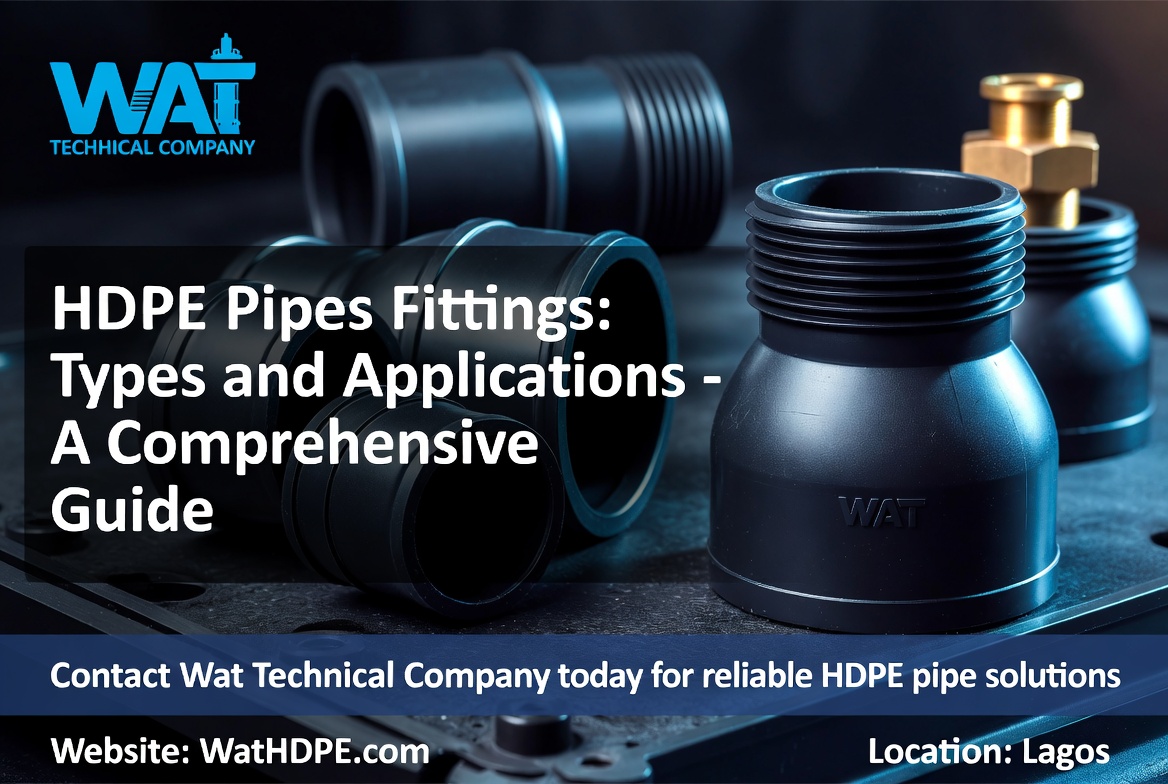
HDPE Pipe Fittings: Types and Applications – A Comprehensive Guide
HDPE pipe fittings are critical components in modern piping systems used for watersupply, sewage and drainage, irrigation, gas distribution, and industrial applications.
Known for their versatility, ease of installation, durability, and environmental sustainability, HDPE fittings ensure secure connections, efficient flow control and long-term system performance.
This comprehensive guide explains the different types of HDPE pipe fittings, their joining methods, and key applications—while highlighting why WAT Technical Company is your trusted source for premium HDPE pipes and fittings.
What Are HDPE Pipe Fittings?
HDPE pipe fittings are designed to connect HDPE pipes or transition between pipe materials while providing leak-free, strong, and reliable joints. Proper selection of fittings is essential to ensure system efficiency, safety, and durability.
Common Types of HDPE Pipe Fittings
1. Couplers
Couplers connect two HDPE pipes in a straight line, forming a secure and leak-proof joint.
2. Elbows
HDPE elbows are used to change the direction of flow, typically at 45° or 90° angles.
They are widely used in water supply, irrigation, sewage, and industrial systems.
Installation methods include butt fusion, electro fusion, and compression.
3. HDPE Reducers
Reducers connect pipes of different diameters, allowing controlled reduction of flow.
They are commonly used where system design requires size transitions and can be installed using butt fusion, electro fusion, or compression methods.
4. HDPE End Caps
End caps are used to seal the end of an HDPE pipe to stop flow temporarily or permanently. Installation options include butt fusion, electro fusion, or compression.
5. HDPE Tees
HDPE tees connect three pipe sections or split flow at a 90-degree angle, forming a “T” configuration.
Types of HDPE Tees
Equal Tee – All outlets have the same diameter
Reducing Tee – Branch outlet has a smaller diameter than the main line
Fabricated Tee – Custom-made fittings produced by welding HDPE pipes for specific project requirements
Types of HDPE Fittings by Joining Method
1. Butt Fusion Fittings
Used to join pipes and fittings of the same diameter by heating and fusing the ends together. This method produces a seamless, strong, and leak-proof joint. Common fittings include elbows, tees, reducers, flange adaptors, and end caps.
2. Electro Fusion Fittings
Electro fusion fittings contain embedded heating coils that fuse the fitting to the pipe using electric current. This method is ideal for water distribution, gas pipelines, and industrial applications requiring highly reliable joints.
3. Socket Fusion Fittings
Socket fusion involves heating the pipe exterior and fitting socket interior before joining. It is typically used for smaller-diameter pipes in water supply and irrigation systems.
4. Compression Fittings
Compression fittings create a mechanical seal by tightening nuts and rings around the pipe—no heat or special equipment required. They are commonly used in low-pressure systems such as irrigation and small water networks.
Applications of HDPE Pipe Fittings
Water Distribution Systems
HDPE fittings are widely used in potable water systems for municipal, residential, commercial, and industrial use. Their corrosion resistance, non-toxicity, and leak-proof joints help minimize water loss and maintenance costs.
Gas Distribution Networks
HDPE fittings are preferred for natural gas and LPG pipelines due to their excellent joint integrity, chemical resistance, and safety performance.
Agricultural Irrigation
HDPE fittings support efficient water delivery to crops through drip and sprinkler systems. Their UV resistance, durability, and ease of installation make them ideal for agricultural environments.
Sewage and Drainage Systems
HDPE fittings provide strong, leak-proof connections for gravity flow and wastewater management systems.
Industrial Applications
HDPE fittings are used for transporting chemicals, process fluids, and industrial waste due to their chemical resistance, corrosion resistance, and long service life.
Conclusion
HDPE pipe fittings are essential for efficient and reliable piping systems across water, gas, irrigation, sewage, and industrial applications. Their durability, adaptability, and resistance to environmental and chemical stress make them a preferred solution for both new installations and system upgrades. Choose WAT HDPE Pipe Fittings for quality, performance, and long-term reliability.
Visit www.wathdpe.com to explore our full range of HDPE pipes and fittings.
HDPE pipe fittings are critical components in modern piping systems used for watersupply, sewage and drainage, irrigation, gas distribution, and industrial applications.
Known for their versatility, ease of installation, durability, and environmental sustainability, HDPE fittings ensure secure connections, efficient flow control and long-term system performance.
This comprehensive guide explains the different types of HDPE pipe fittings, their joining methods, and key applications—while highlighting why WAT Technical Company is your trusted source for premium HDPE pipes and fittings.
What Are HDPE Pipe Fittings?
HDPE pipe fittings are designed to connect HDPE pipes or transition between pipe materials while providing leak-free, strong, and reliable joints. Proper selection of fittings is essential to ensure system efficiency, safety, and durability.
Common Types of HDPE Pipe Fittings
1. Couplers
Couplers connect two HDPE pipes in a straight line, forming a secure and leak-proof joint.
2. Elbows
HDPE elbows are used to change the direction of flow, typically at 45° or 90° angles.
They are widely used in water supply, irrigation, sewage, and industrial systems.
Installation methods include butt fusion, electro fusion, and compression.
3. HDPE Reducers
Reducers connect pipes of different diameters, allowing controlled reduction of flow.
They are commonly used where system design requires size transitions and can be installed using butt fusion, electro fusion, or compression methods.
4. HDPE End Caps
End caps are used to seal the end of an HDPE pipe to stop flow temporarily or permanently. Installation options include butt fusion, electro fusion, or compression.
5. HDPE Tees
HDPE tees connect three pipe sections or split flow at a 90-degree angle, forming a “T” configuration.
Types of HDPE Tees
Equal Tee – All outlets have the same diameter
Reducing Tee – Branch outlet has a smaller diameter than the main line
Fabricated Tee – Custom-made fittings produced by welding HDPE pipes for specific project requirements
Types of HDPE Fittings by Joining Method
1. Butt Fusion Fittings
Used to join pipes and fittings of the same diameter by heating and fusing the ends together. This method produces a seamless, strong, and leak-proof joint. Common fittings include elbows, tees, reducers, flange adaptors, and end caps.
2. Electro Fusion Fittings
Electro fusion fittings contain embedded heating coils that fuse the fitting to the pipe using electric current. This method is ideal for water distribution, gas pipelines, and industrial applications requiring highly reliable joints.
3. Socket Fusion Fittings
Socket fusion involves heating the pipe exterior and fitting socket interior before joining. It is typically used for smaller-diameter pipes in water supply and irrigation systems.
4. Compression Fittings
Compression fittings create a mechanical seal by tightening nuts and rings around the pipe—no heat or special equipment required. They are commonly used in low-pressure systems such as irrigation and small water networks.
Applications of HDPE Pipe Fittings
Water Distribution Systems
HDPE fittings are widely used in potable water systems for municipal, residential, commercial, and industrial use. Their corrosion resistance, non-toxicity, and leak-proof joints help minimize water loss and maintenance costs.
Gas Distribution Networks
HDPE fittings are preferred for natural gas and LPG pipelines due to their excellent joint integrity, chemical resistance, and safety performance.
Agricultural Irrigation
HDPE fittings support efficient water delivery to crops through drip and sprinkler systems. Their UV resistance, durability, and ease of installation make them ideal for agricultural environments.
Sewage and Drainage Systems
HDPE fittings provide strong, leak-proof connections for gravity flow and wastewater management systems.
Industrial Applications
HDPE fittings are used for transporting chemicals, process fluids, and industrial waste due to their chemical resistance, corrosion resistance, and long service life.
Conclusion
HDPE pipe fittings are essential for efficient and reliable piping systems across water, gas, irrigation, sewage, and industrial applications. Their durability, adaptability, and resistance to environmental and chemical stress make them a preferred solution for both new installations and system upgrades. Choose WAT HDPE Pipe Fittings for quality, performance, and long-term reliability.
Visit www.wathdpe.com to explore our full range of HDPE pipes and fittings.
0 comments